
Safe Distance Requirements for Machine Safeguarding Devices

When it comes to machine safety, safe distance requirements are one of the most critical — and often misunderstood — elements of compliance. In Ontario, employers are legally obligated under the Occupational Health and Safety Act (OHSA), Regulation 851 to ensure workers are protected from hazardous machine motion. This is often achieved using interlocked guards, light curtains, or area scanners. But simply installing and integrating these control devices is not enough — they must be positioned at the correct distance from the hazard zone to truly protect workers.
Why Safe Distance Matters
If a safeguarding device is too close to a hazard, workers may reach dangerous areas before the machine stops. Safe distance ensures there is enough time for the machine to stop after the device detects an intrusion. Incorrect placement undermines the entire safeguarding system — leaving workers vulnerable and employers liable.
Applicable Standards and Codes
Safe distance requirements are governed by both Ontario law and internationally recognized standards:
- CSA Z432 — Safeguarding of Machinery
- ISO 13855 — Positioning of safeguards with respect to approach speeds
- CSA Z142 — Power Press Operation
- CCOHS — General Machine Guarding Guidelines
Together, these standards provide formulas and requirements for positioning safeguarding devices such as interlocked barrier guards, light curtains, and scanners.
Safe Distance for Interlocked Guards
Interlocked guards and safety detection devices, when connected to a monitoring system, must prevent access to danger zones until the hazardous motion has stopped. Safe distance is calculated based on machine stopping time, control system response time, and guard placement. For example, hinged or sliding doors must be far enough away to prevent a worker from reaching into the danger zone during the stop delay.
Safe Distance for Light Curtains
Light curtains create an invisible protective field. The safe distance is typically calculated using the formula defined in ISO 13855:
S = K × T + C
- S = Minimum safe distance (mm)
- K = Approach speed of the body/hand (mm/s)
- T = Total system stopping time (s)
- C = Additional distance based on device resolution (mm)
This ensures the machine has enough time to stop before a hand or body part reaches the hazard. Placement depends on resolution, response time, and stopping performance.
Safe Distance for Area Scanners
Area scanners (laser-based devices) protect operators by monitoring a configurable 2D field. They allow for multiple zones — typically a warning zone and a safety zone. The protective distance is calculated based on approach speed and stopping time, ensuring the scanner triggers a safe stop before entry into the hazard zone. These are widely used in robotic cells and automated guided vehicles (AGVs).
HITE Engineering’s Safe Distance Evaluations
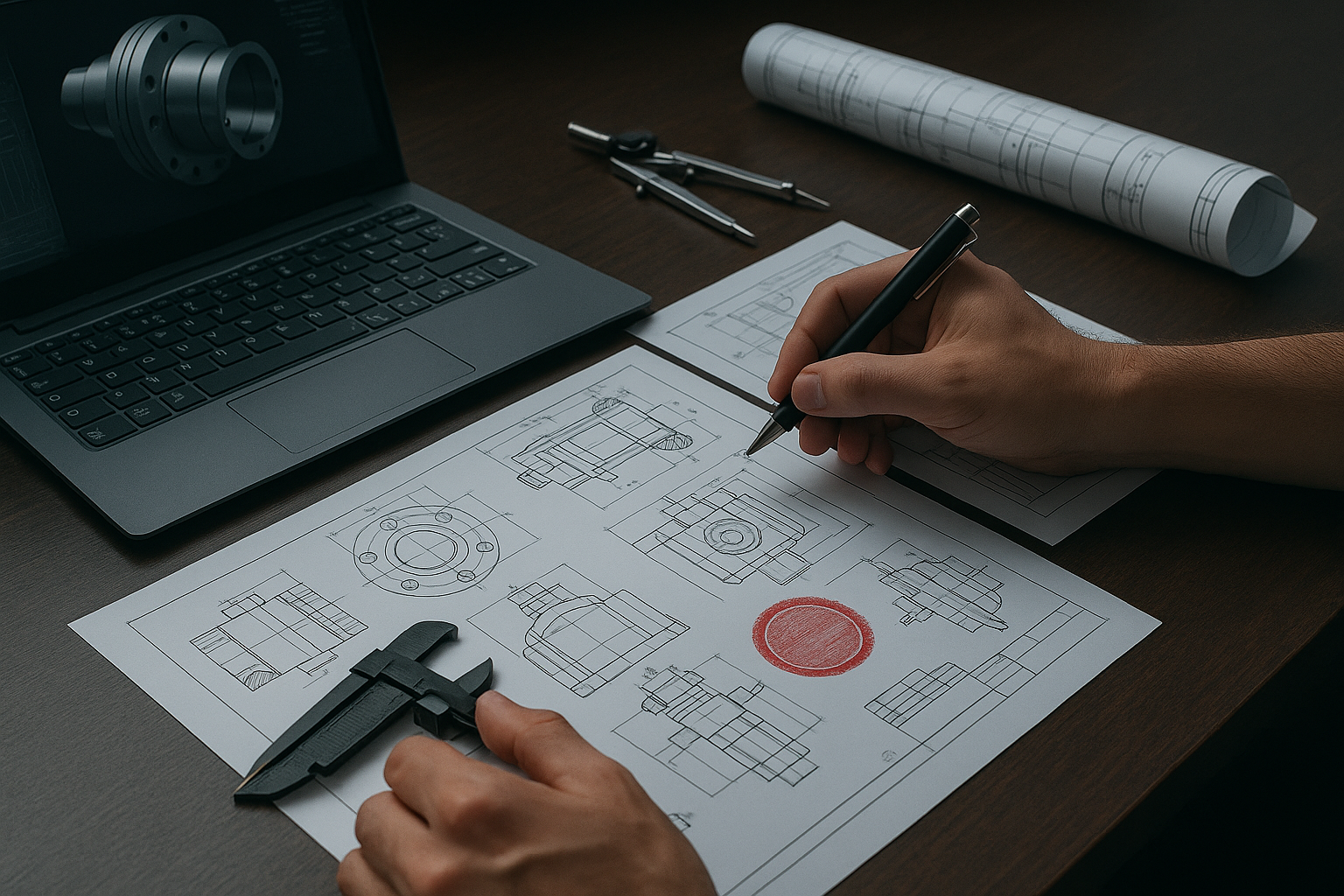
At HITE Engineering, we specialize in evaluating whether safeguarding devices meet required safe distance standards. Our licensed Professional Engineers perform:
- On-site measurements and safety inspections
- Stopping time analysis and verification
- Safe distance calculations per ISO 13855
- Design recommendations for compliant guard placement
- Signed and sealed reports for due diligence and liability protection
Why Safe Distance Compliance is Critical
- Prevents serious workplace injuries and fatalities
- Ensures compliance with OHSA and CSA standards
- Protects employers from liability, fines, and stop-work orders
- Improves worker confidence and operational efficiency
FAQ: Safe Distance Requirements for Machine Safeguarding
What is a safe distance in machine safeguarding?
A safe distance is the minimum separation between a safeguarding device (like a guard, light curtain, or scanner) and a hazard zone, ensuring the machine stops before a worker can reach the hazard.
Which standards define safe distance requirements in Ontario?
Key standards include CSA Z432 (Safeguarding of Machinery), ISO 13855 (Safe distance calculations), and CSA Z142 (Power Press Operation). These are enforced under Ontario Regulation 851 of the OHSA.
How is safe distance for light curtains calculated?
Safe distance is calculated using the formula S = K × T + C, where S is the minimum distance, K is approach speed, T is machine stopping time, and C is a constant for resolution. This ensures hands or bodies cannot reach the hazard before the stop is complete.
How often should safe distance compliance be checked?
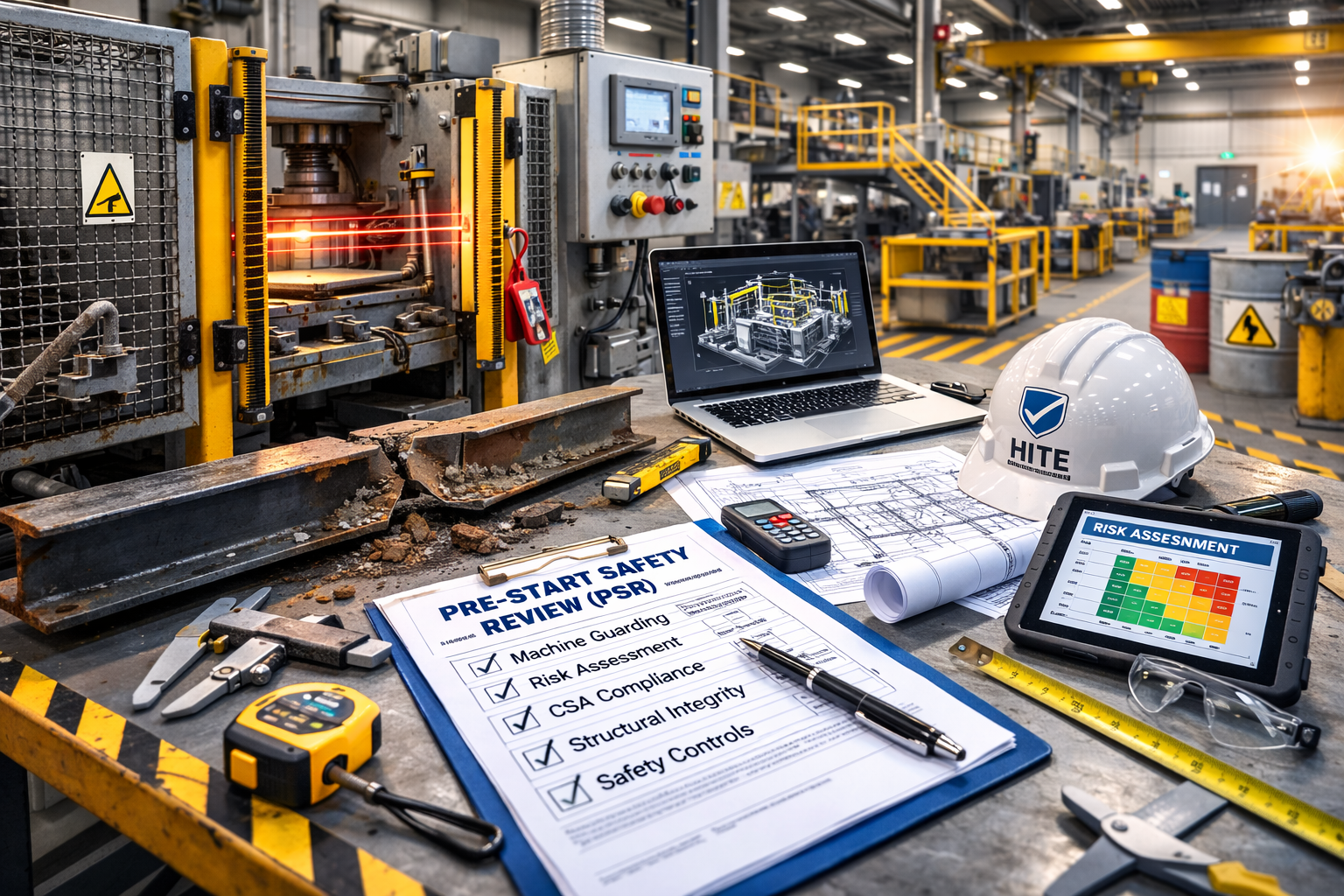
Safe distance should be re-evaluated whenever new equipment is installed, machinery is modified, or safety devices are relocated. Regular safety audits and Pre-Start Health & Safety Reviews (PSRs) are recommended.
Can a Professional Engineer certify safe distance compliance?
Yes. In Ontario, only a licensed Professional Engineer (P.Eng.) can sign and seal an evaluation confirming compliance with OHSA and CSA requirements. HITE Engineering provides certified safe distance evaluations.
Book a Safe Distance Evaluation
Do you have interlocked guards, light curtains, or scanners in your facility? Ensure they meet the required safe distance standards before an inspector finds deficiencies. Contact HITE Engineering today to schedule a safe distance evaluation by a licensed Professional Engineer.